
Matt Singer
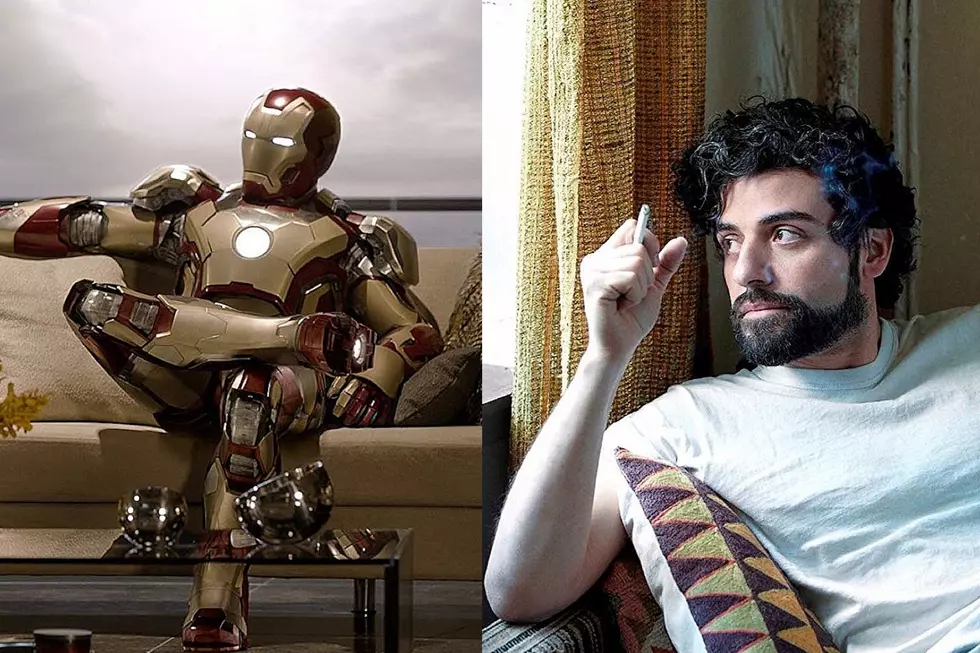
From the earliest days of his appearances in Marvel Comics' 'Tales of Suspense,' Tony Stark has always been modeled after aviator/inventor/industrialist Howard Hughes. With 'Iron Man 3,' Stark assumes a new dimension of Hughes' persona: that of the paranoid shut-in who, in his later years, became notorious for roaming his private floor of the Desert Inn Hotel in Las Vegas, freaking out about invisible germs and collecting jars of his own urine. 'Iron Man 3's' Tony Stark, played once again by the inimitable Robert Downey Jr.isn't quite that bad, but he's getting there.
After the events chronicled in 'The Avengers,' where Manhattan was nearly leveled by invading aliens and Tony himself was almost killed, he's become obsessed with upgrading his armor -- leaping all the way from the Mark VII to the Mark 42 in a matter of months. When anyone mentions New York or aliens, Tony gets panic attacks. There's a reason Daredevil, not Iron Man, is the Marvel hero known as "The Man Without Fear." Poor Tony is terrified.
James Franco might not be the best actor working in movies today, but he's almost certainly the most fearless. His choices are as unpredictable as they are gutsy. He'll try just about anything: television dramas ('Freaks & Geeks'), soap operas ('General Hospital'), comedies ('Pineapple Express'), and big blockbusters ('Spider-Man,' 'Rise of the Planet of the Apes'). His latest role, in Harmony Korine's 'Spring Breakers,' might be his craziest and most daring to date. He plays Alien -- pronounced "A-Leen" in Franco's South Florida drawl -- a drug dealer and aspiring rapper who likes to boast that he's from another planet. Franco's performance is suitably extraterrestrial: hilarious, disturbing, deranged, poignant and endlessly quotable. In an instant classic scene, Alien shows off all his prized possessions -- machine guns and money and nunchucks and 'Scarface' DVDs on constant repeat -- while screaming "Look at my s---!" Alien's orders are superfluous; any time Franco's onscreen, you can't take your eyes off him.
In 1982, Walter Hill directed '48 Hrs.,' with Nick Nolte as a loose cannon cop and Eddie Murphy as a fast-talking criminal. The oil-and-water chemistry worked, the movie was a hit, and an entire genre -- the buddy cop movie -- was born. Hill has had a long a varied career in Hollywood, directing tough, lean action movies and Westerns and producing the 'Alien' franchise, but '48 Hrs.' and the myriad imitators it birthed will always be his biggest legacy. That fact alone makes his new movie, 'Bullet to the Head,' interesting, since it's Hill imitating himself, with his first return to the genre since 1990's 'Another 48 Hrs.' The mixed results probably won't inspire a resurgence of buddy cop movies, but they're not terrible either, with enough Walter Hill flair to make some moments quite memorable, even if the movie as a whole has its problems.
Seconds into 'Deadfall,' the lives of two of the main characters are sent careening off course by a fluke accident. They are siblings Addison (Eric Bana) and Liza (Olivia Wilde), making a fast getaway from a casino robbery. They're driving down a snowy road when a deer darts in front of their car, smashing through the windshield and flipping the vehicle into the woods. If everything had gone according to plan, Addison and Liza would have escaped. Through sheer coincidence, they did not.
Many of Alfred Hitchcock's movies, from 'Psycho' to 'Vertigo' to 'Rear Window,' are about voyeurism, so the idea of peering into Hitchcock's own previously hidden private life does make a certain amount of sense. But if 'Hitchcock' resonates with some of the Master of Suspense's ideas, it's never faithful to his spirit. Hitch would never have put his name on a film so full of lame pop psychology and so bereft of excitement, tension and humor. Which is a shame, since the title of this movie is his name.
If its portrait of him is accurate, then Abraham Lincoln would have loved Steven Spielberg's 'Lincoln.' The film is exactly like the man at its center: thoughtful and talkative, equally adept at spinning tales and navigating the murky waters of backroom politics. It suggests that well before Ronald Reagan, our 16th President was truly our nation's Great Communicator.
Movies allow us to experience life through another person's eyes. Video games allow us to experience life through another person's eyes -- and to control their decisions. We spend hours upon hours with these video game characters, until we feel like we know them; Mario, Sonic, Pac-Man, their adventures are so memorable, and their personalities so vivid that they almost seem alive. But of course their adventures and their personalities are all predetermined by programming, and they remain forever trapped by their unbreakable directives. If these characters weren't just a series of electronic impulses and computer code, it would be a tragic existence.
That, essentially, is the premise of 'Wreck-It Ralph,' a manic children's film about the souls of video game avatars. Made by Disney, it greatly resembles the premise of Disney's (and Pixar's) modern classic 'Toy Story,' in which toys are revealed to have lives and thoughts of their own when no one's around to play with them. Here we learn that when a suburban arcade shuts down for the night, the characters inside all the games cross over into each other's universes to socialize.
Matt had just typed out the title of his 'Seven Psychopaths' review, his byline, and the rating (seven -- no, make that eight --out of ten?) when his wife Melissa walked into the room.
"How was the movie?" she asked as she flopped down on the couch and flipped on the television.
"Good. Really good," Matt replied. "Interesting."
"Interesting? Why interesting?" Melissa said. She started flipping channels.
"It's about a writer who writes himself into his work. Colin Farrell plays this struggling screenwriter named Martin -- and the movie was written and directed by this guy, Martin McDonagh, who wrote that play we saw on Broadway with Christopher Walken in it."
"Right. That was weird."
"It was," he said, nodding. "Weird but good. So, anyway, Colin Farrell plays this writer named Martin. He's come up with a title he really likes for a screenplay -- 'Seven Psychopaths.' But that's all he has, the title. He doesn't even have the seven psychopaths. But then these people in his life -- or perhaps these characters he's invented -- are all revealed to be psychopaths, and he gets caught in the middle of this elaborate gangster-slash-revenge comedy with them involving a kidnapped dog."
Melissa yawned again. "A writer writing himself into his work? That sounds like a terrible idea."